
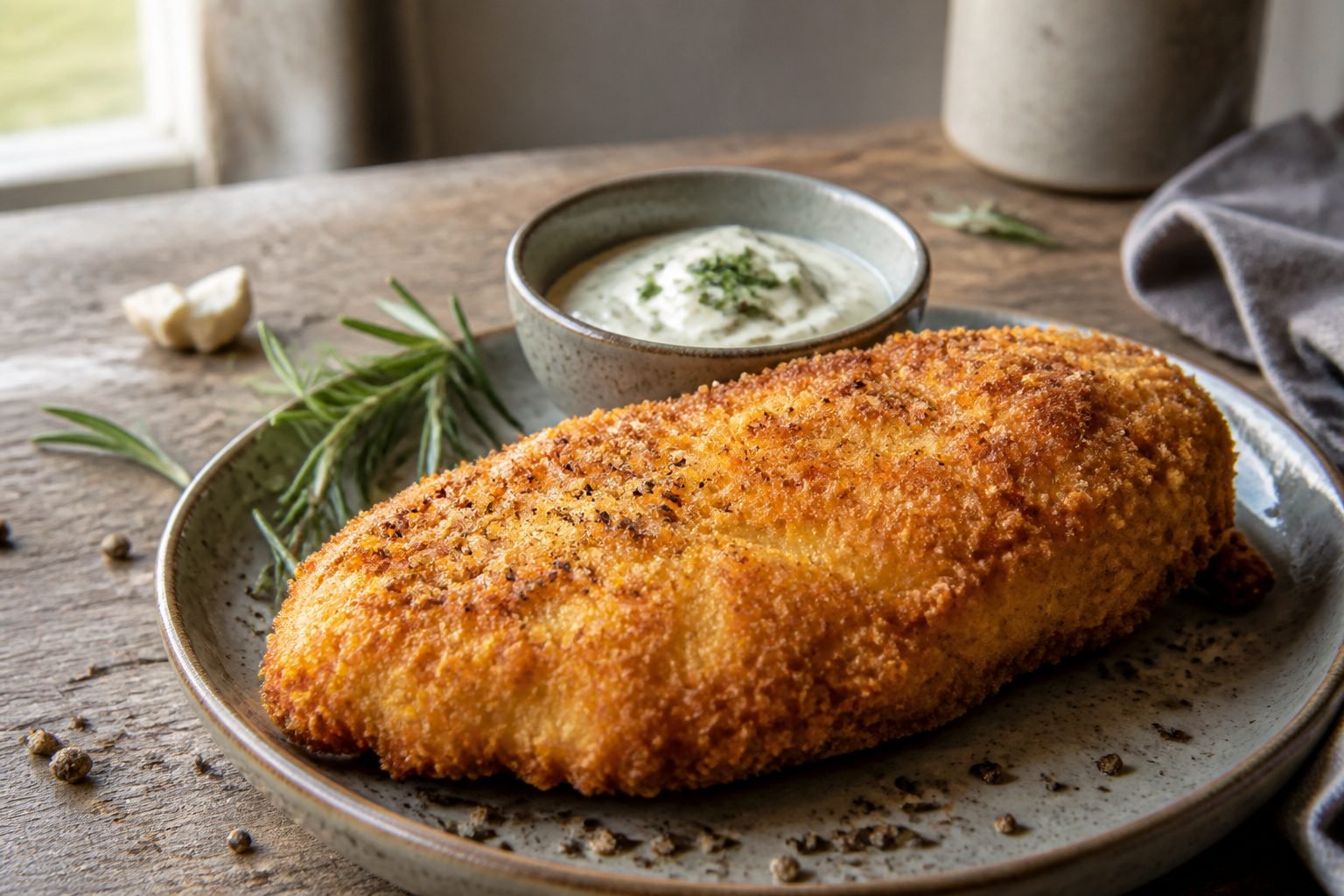
Keto breaded chicken replaces breadcrumbs with pulverized pork rinds to build a zero-carb crust that still shatters when you bite.
The cost of that swap is moisture: egg wash made with heavy cream instead of almond milk, and a hard press into the coating so the crumbs do not slide off in the pan.
A 350°F oven runs 20 to 30 minutes, but the only number that matters is 165°F.
1. Prepare the Chicken

Trim the chicken of any fat or connective tissue, then pound each breast to about 1/4 inch thick.
An even thickness matters more than you’d think: thin spots overcook and turn leathery before the thick parts hit 165°F, and the coating browns unevenly where it sits on ridges instead of lying flat.
A meat mallet works, but the bottom of a heavy skillet does the same job.
Chicken thighs work too, and they stay juicier through the high heat you’ll need for a crisp crust.
Thighs bring more fat and a less uniform shape, so you’ll spend a little longer trimming and pounding to get them to lie right.
Either way, pat the meat dry with paper towels before you move on. Moisture left on the surface turns the first layer of breading gummy, and by then the crisp is already compromised.
Recommended Products

NO CARBS: For those of you following a ketogenic diet, paleo diet, bariatric diet, gluten-free, diabetic diet, or just watching your carbs, you'll now be able to enjoy your favorite foods again without the guilt! Each serving of our Pork King Good Pork Rind Crumbs is carb free with 0 carbs per serving
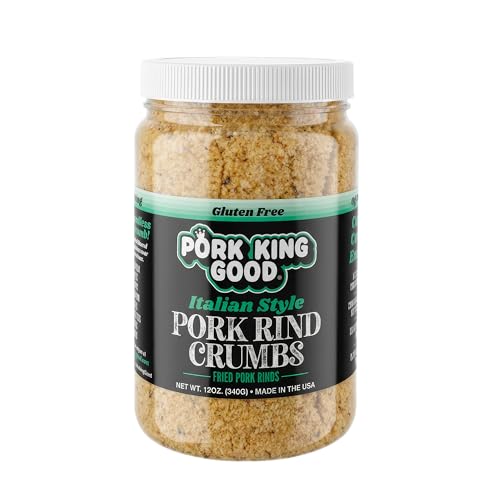
NO CARBS: For those of you following a ketogenic diet, paleo diet, bariatric diet, gluten-free, diabetic diet, or just watching your carbs, you'll now be able to enjoy your favorite foods again without the guilt! Each serving of our Pork King Good Pork Rind Crumbs has absolutely no carbs
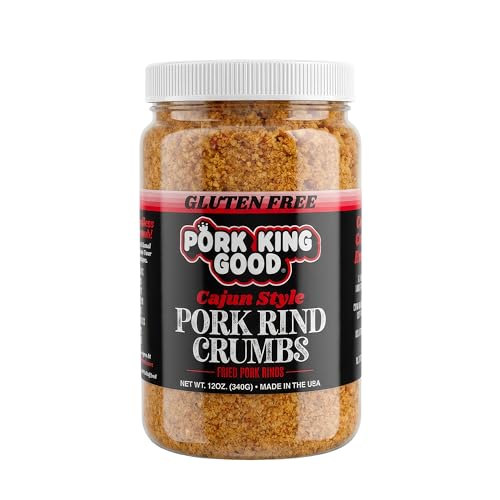
NO CARBS: For those following a ketogenic diet, paleo diet, bariatric diet, gluten-free, diabetic diet, or just watching your carbs, you'll now be able to enjoy your favorite foods again without the guilt! Each serving of our Pork King Good Pork Rind Crumbs has absolutely no carbs
2. Make the Egg Wash

The egg wash is what keeps the breading from sliding off into the pan.
Two eggs whisked with a splash of liquid is the standard base, and for keto breaded chicken the choice between almond milk and heavy cream actually changes the finish.
Almond milk thins the eggs without adding carbs, which keeps the coating light.
Heavy cream brings fat into the mix, and that fat helps the almond flour or pork rind breading turn golden and crisp at the edges rather than pale and soft.
The difference is noticeable after the first flip. Cream also thickens the wash slightly, so the breading clings in a more even layer instead of spotting.
I reach for cream when I want the chicken to look like it came out of a fryer, even if I am baking it.
The trade is a few extra calories and a richer flavor that can read almost buttery against the neutral meat.
Almond milk keeps things leaner and lets the seasoning in the breading stand alone. Either works, but the pan result favors fat.
Recommended Products

REVEALS EGGS’ NATURAL BEAUTY: Helps restore clean, attractive shells by gently removing dirt, grime, and surface contaminants

PLANT-BASED FORMULA YOU CAN TRUST: Created with 99% food-grade ingredients, this naturally derived solution harnesses plant-based enzymes to gently cleanse farm-fresh eggs—no harsh chemicals, dyes, or artificial foaming agents involved. A thoughtful choice for those who value simplicity and safety in their routines.

MADE FOR BACKYARD EGG COLLECTORS: Whether you're gathering from a coop or a carton, this thoughtfully engineered egg brush was built with backyard chicken lovers in mind. Designed for standard-sized eggs, it’s a must-have for anyone who appreciates the charm—and challenge—of fresh, unprocessed eggs.
3. Mix the Breading

Pork rinds pulverize into something that behaves almost exactly like breadcrumbs once they hit hot oil or air. The fat in them crisps rather than melts, so you get that shattering crunch without a single gram of carbohydrate.
I run mine through the food processor until the texture looks like coarse sand, though a blender works if you pulse carefully.
Parmesan does more than add salty, savory depth here. The aged cheese dries out as it cooks, helping the coating cling to the chicken and form a solid, golden shell instead of flaking off in patches.
Some recipes call for as little as a quarter cup, others push toward a full cup matched to three quarters cup of rinds. The more Parmesan, the sturdier your crust.
For seasoning, Italian seasoning and garlic powder are the reliable starting points. The dried herb blend covers the slightly porky edge that plain rinds can leave behind, and garlic powder disperses evenly where fresh minced garlic would clump.
I mix everything in a shallow dish, the kind you can lay a cutlet flat in without curling the edges.
Two cups of pork rind crumbs to a quarter cup of grated Parmesan is the ratio that has worked most consistently for me, seasoned with about two teaspoons each of Italian seasoning and garlic powder.
Recommended Products

✓ Carb Free. Friendly to Keto, Paleo, Diabetic, Bariatric Diet
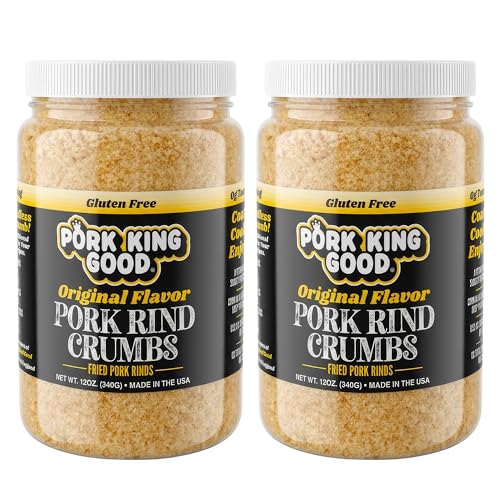
Zero Carb Keto-Friendly Alternative: For those following a ketogenic diet, paleo diet, bariatric diet, gluten-free, diabetic diet, or just watching your carbs, you'll now be able to enjoy your favorite foods again without the guilt! Each serving of our Pork King Good Pork Rind Crumbs has absolutely no carbs

Pack of 18, 1.75-ounce bags of original microwave pork rinds (31.5 total ounces)
4. Coat the Chicken

The egg wash goes in the middle bowl, the breading in the last.
Pick up a piece of chicken with your left hand, drop it in the egg, and let your right hand stay dry. Switch hands to move the chicken into the breading, then press.
Pressing matters more than most people bother with; the coating needs contact with the surface or it will slide off in the pan and leave bare spots. I press once, flip, press again, and tap off the excess.
The dry-hand-wet-hand method keeps your fingers from building up that paste of almond flour and pork panko that turns into wasted coating and clumpy fingertips. Two minutes of discipline here saves ten minutes of scraping your hands clean later.
Recommended Products

One 1.56 lb bag of Tyson Frozen Crispy Chicken Breast Strips

NO ANTIBIOTICS EVER: Chicken used is all natural, minimally processed, raised without antibiotics and free from added hormones, steroids, artificial ingredients and preservatives

5. Cook Until 165°F

A 350°F oven turns out evenly cooked tenders in 20 to 30 minutes, while a 400°F air fryer needs only 6 to 7 minutes on the first side and 5 to 6 after the flip.
Pan frying in 350°F oil sits somewhere in the middle, though the exact time depends on how thick the cut is and how crowded the pan gets.
The only number that actually matters is 165°F internal temperature. That is the hard stop, whether the method takes 12 minutes or 75.
I have learned to pull the chicken the instant it hits that mark, then let it rest for a few minutes before anyone touches it.
The coating stays crisper that way. Cutting too early steams the breading from underneath, and all the work on the crust goes soft.
Recommended Products

IMPROVES QUALITY AND CONSISTENCY: By accurately gauging and indicating when a food item has reached its optimum internal temperature, any cook can be assured that their meal has been cooked properly each and every time

【Fast & Accurate】Our meat thermometer digital delivers accurate readings within ±1°F in just 1–2 seconds, with a wide temperature range of -58°F to 572°F (-50°C to 300°C). No more waiting over the heat - know your food's exact temperature instantly.
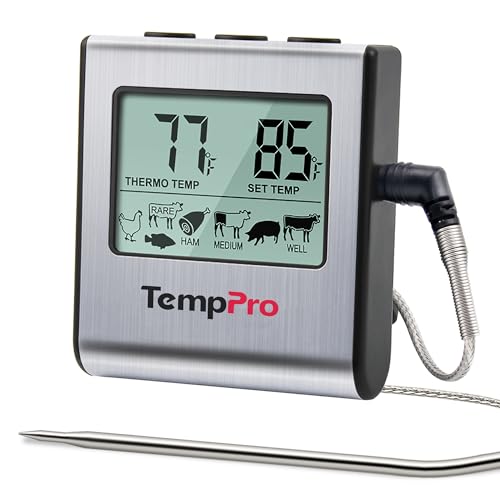
Cook mode with USDA preset temperature settings: TempPro cooking thermometer ideal for meat, oven, smoker or stove top; Programmable alert with preset temperatures for specific foods recommended by USDA; All of the preset temps can be reset to your desired tastes
Breading Options Compared

Almond flour is the obvious starting point because most people already have it in their pantry.
It worked, but the coating turned out softer than I wanted. That sent me down a rabbit hole of alternatives.
Pork rinds deliver the crunch closest to real breadcrumbs because their fat content crisps in hot oil. Almond flour creates an even base layer that helps the egg stick, though it stays more tender than crisp.
Coconut flour adds subtle flavor and structure but can dry out quickly if you use too much. Psyllium husk acts more like a binder, helping the mixture cling to the chicken without adding much taste or texture on its own.
Parmesan shows up in nearly every blend because its dry, salty nature adds both flavor and a secondary crisping agent. It also fills in gaps where the main base might fall short.
| Base | Texture | Carbs | Where to Find It | Best For |
|---|---|---|---|---|
| Pork rinds / pork panko | Audibly crunchy, golden crust | 0 g | Grocery stores, online | Outer coating |
| Almond flour | Even, slightly nutty, softer | Low | Baking aisle, bulk bins | First dredge layer |
| Coconut flour | Light, slightly sweet, fragile | Low | Health food section | Flavor accent |
| Psyllium husk | Binding, minimal texture | Very low | Supplement aisle, online | Holding the coating together |
Store-bought pork panko grinds finer and more uniformly than crushing rinds yourself, which matters for getting the coating to adhere without bare spots.
Recommended Products

NO CARBS: For those of you following a ketogenic diet, paleo diet, bariatric diet, gluten-free, diabetic diet, or just watching your carbs, you'll now be able to enjoy your favorite foods again without the guilt! Each serving of our Pork King Good Pork Rind Crumbs has absolutely no carbs

Zero Carb Keto-Friendly Alternative: For those following a ketogenic diet, paleo diet, bariatric diet, gluten-free, diabetic diet, or just watching your carbs, you'll now be able to enjoy your favorite foods again without the guilt! Each serving of our Pork King Good Pork Rind Crumbs has absolutely no carbs

Baking, Frying, or Air Frying

Baking gives you the most even crust but demands 20–25 minutes at 425°F and a sheet pan to scrub. Frying on the stove yields the shatteriest coating, yet it soaks up oil and leaves you wiping splatter off the backsplash.
The air fryer lands in the middle on crispiness, running 360°F–400°F for 12–15 minutes, flipped halfway, and the basket cleans faster than a skillet.
| Method | Crispiness | Time | Oil | Cleanup |
|---|---|---|---|---|
| Baking | Moderate–High | 20–25 min | Minimal | Moderate |
| Frying | Highest | 8–12 min | Most | Hardest |
| Air Frying | Moderate | 12–15 min | Light spray | Easiest |
I lean air fry for weeknights. The pork panko still turns golden, and I am not standing over hot oil while the kids ask about homework.
If your first batch looks pale, bump to 400°F. If the coating darkens before the chicken hits 165°F inside, drop to 360°F and add a few minutes.
Recommended Products
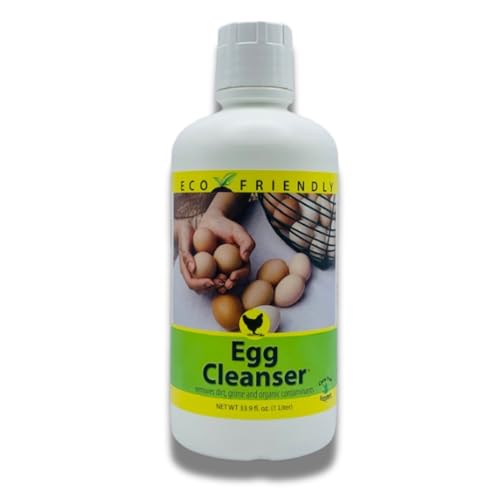
SAFE & NATURAL EGG WASHING — CareFree Enzymes Egg Cleanser uses plant-based food-grade enzymes to safely remove dirt, bacteria, fecal matter, blood, and protein residue from fresh farm eggs. A gentle alternative to harsh detergents and bleach — won't damage the bloom (cuticle) or leave chemical residue on your eggs.

MADE FOR BACKYARD EGG COLLECTORS: Whether you're gathering from a coop or a carton, this thoughtfully engineered egg brush was built with backyard chicken lovers in mind. Designed for standard-sized eggs, it’s a must-have for anyone who appreciates the charm—and challenge—of fresh, unprocessed eggs.
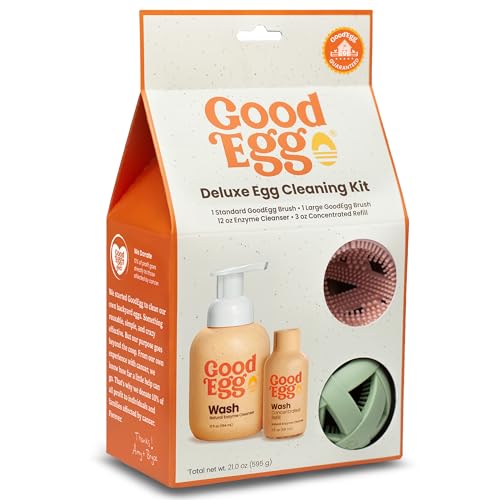
EVERYTHING YOU NEED FOR FRESH EGGS: This deluxe kit pairs two silicone brushes (standard and XL) with our enzyme-powered wash plus a concentrated refill so backyard chicken keepers can scrub, soak, and store eggs without bleach, soap, or harsh chemicals
Ingredient Variations

The coating mix is where you can make this recipe yours without breaking the carb budget.
- Almond flour stands in for pork rinds as the dry base layer. Blanched almond flour coats more smoothly than almond meal, which still has the skin and turns out grainy. The Kirkland bag at Costco is what I keep on hand now; it lasts forever in the freezer.
- Coconut flour works too, though it absorbs more moisture. If you go this route, use less and let the chicken sit a minute after the first coat so the flour hydrates.
- Pork panko, the commercial grind, crisps louder than anything you can crush yourself. Store-bought pork rinds hold more moisture, so the coating falls off or turns uneven. The pre-ground stuff is worth finding.
- Parmesan and psyllium husk bulk out the breading without adding carbs. I keep a jar of the pork-rind-Parmesan-oregano blend in the pantry; it fries up the same three months later.
- For seasoning, dried oregano is the baseline. Cayenne, garlic powder, onion powder, or a spoonful of Italian seasoning all work. The 4C plain breadcrumbs, if you keep them around for non-keto nights, take herbs and grated cheese the same way.
Recommended Products

PROTEIN SNACK: Satisfy your crunch cravings with crunchy, light pork rinds that pack 11g of protein per serving
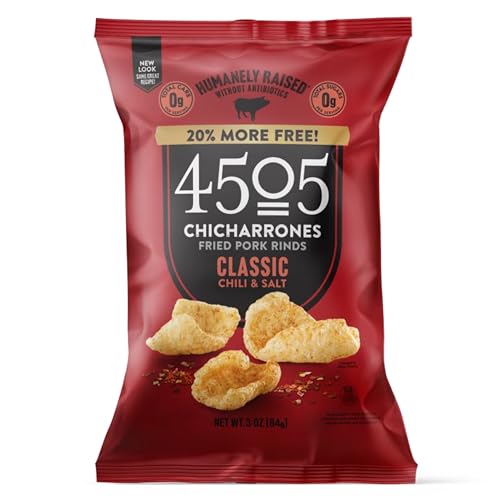
4505 Classic Chili and Salt Pork Rinds: Our Classic Chili & Salt chicharrones are seasoned with a blend of chili peppers, salt, and a special blend of spices. The sweet & spicy balance makes them perfect for dipping in salsa or enjoying on their own! Pack of 12 (3oz) bags.

ELEVATED BLANCHED ALMOND FLOUR, NATURALLY SKIN-FREE AND PREMIUM CALIFORNIA ALMONDS: Contains a 13 ounce bag of Barney Butter Blanched Almond Flour with one simple ingredient - ground, natural, skin-free almonds. It is a perfect baking option for your low-carb, paleo, glueten-free recipes, or just a healthier protein kick.
Storage and Reheating

Leftover keto breaded chicken keeps in an airtight container in the refrigerator for 4 to 5 days. The coating stays more intact in a rigid container than in a bag, where the fragile crust can crack and flake off.
For longer storage, freeze the pieces in a single layer on a parchment-lined sheet until solid, about an hour, then transfer to a freezer bag. They hold for up to 3 months this way.
Reheating is where most people lose the crispiness they worked for.
The microwave steams the coating and turns it soft, so skip it entirely. An oven set to 400°F takes 8 to 10 minutes for refrigerated pieces, or 15 to 18 minutes straight from frozen.
An air fryer at 375°F does the job faster: 4 to 5 minutes for refrigerated, 10 to 12 minutes from frozen. Either way, the chicken comes back with a crunch that still tastes like dinner, not leftovers.
Recommended Products


Meets standards for animal welfare, feed, and more, so you can know about what you're buying (and eating)
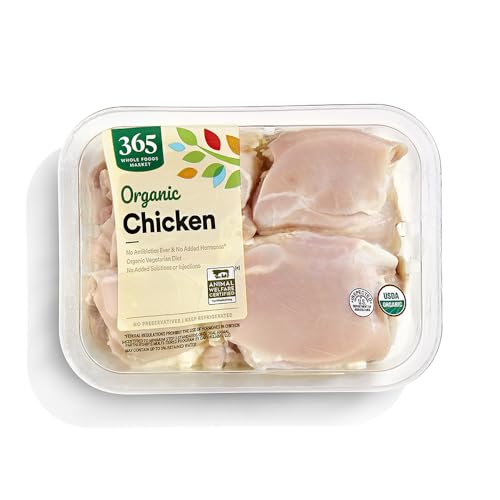
365 by Whole Foods Market products give you that dance-down-the-aisles feeling, virtual aisles too! Our huge range of choices with premium ingredients at prices you can get down with makes grocery shopping so much more than tossing the basics in your cart.
Frequently Asked Questions
Recommended Products

Fast & Accurate: Get precise readings in just 1 second with ±0.9°F accuracy. NSF Certified for trusted food safety, this digital food thermometer features a 4.3 inches food-grade stainless steel meat probe, perfect for grilling, frying, baking, making candy and more

BBQ HI/LOW temp range alarm: Set your desired food temp and HI/LOW temp range for your grill or smoker to know when to add more fuel smoker thermometer will flash and beep to remind you if the temperature ever goes out your set range; HI/LOW temp range alarm is specifically designed for usage with smokers, grills and BBQs

FOOD SAFETY: Thermometer displays true oven temperature instantly to ensure safe food preparation
How do I make keto breaded chicken?
Pound chicken to 1/4 inch thick, dip in an egg wash made with heavy cream or almond milk, press into a coating of pork rind crumbs and Parmesan, then cook until the internal temperature hits 165°F. The dry-hand-wet-hand method keeps your fingers clean and the breading where it belongs.
Can I use chicken thighs instead of breasts?
Yes.
Thighs stay juicier through high heat, though they need more trimming and pounding to lie flat. Breasts give a more uniform shape but dry out faster if you overshoot the temperature.
What is the best way to store leftovers?
Keep leftover keto breaded chicken in a rigid airtight container in the refrigerator for 4 to 5 days.
The hard sides protect the fragile crust better than a bag. For longer storage, freeze pieces in a single layer on parchment until solid, then bag them; they keep for up to 3 months.
What is a low-carb recipe for chicken cutlets?
Pound cutlets to 1/4 inch, dredge in a mix of pork rind crumbs and Parmesan bound with an egg wash, then bake at 425°F for 20–25 minutes or air fry at 360°F–400°F for 12–15 minutes.
Pork rinds give the crunch closest to real breadcrumbs without adding carbs.
Can you eat fried chicken on keto if you take the skin off?
Removing the skin does not make standard fried chicken keto-friendly.
The breading itself is made from wheat flour, which carries most of the carbs. You would need to replace that coating with a low-carb alternative like pork rinds or almond flour to stay within keto limits.
What chicken is best on keto?
Any plain chicken works, since the meat itself is naturally low in carbs.
Breasts are leaner and easier to pound uniform; thighs have more fat, which helps on keto and keeps the meat moist through the high heat needed for a crisp crust.
About The Author
